
Products Knowledge
Beverage Factory Vietnam with International Certifications
Jul
Choosing a reliable Beverage Factory Vietnam is an important decision for international beverage brands, importers, distributors, retailers, and private label businesses looking for quality manufacturing partners in Asia. Beyond production capacity and competitive pricing, modern beverage buyers increasingly evaluate food safety systems, international certifications, quality control procedures, product development capabilities, and export readiness before selecting a supplier.
Vietnam has developed into an attractive destination for beverage manufacturing due to its agricultural resources, growing food-processing industry, skilled workforce, and strategic position in Southeast Asia. A professional beverage factory can provide comprehensive manufacturing solutions covering formulation, ingredient sourcing, processing, filling, packaging, quality assurance, warehousing, and export support.
International certifications are particularly important because they demonstrate that manufacturing processes are managed according to recognized food safety and quality principles. Certifications such as HACCP, GMP, ISO-based systems, FSSC 22000, HALAL, and market-specific requirements can provide additional confidence to global buyers.
For brands seeking long-term manufacturing partnerships, however, certifications should be considered alongside actual factory capabilities, traceability, R&D expertise, production technology, and the ability to maintain consistent quality at commercial scale.
1. Why Choose a Beverage Factory Vietnam for Global Beverage Production?
Vietnam has become increasingly attractive for businesses seeking beverage manufacturing partners. The combination of agricultural resources, production capabilities, workforce availability, and export infrastructure provides several advantages for international brands.
Strong Agricultural Resources
Vietnam is well known for its diverse agricultural production, particularly tropical fruits and other ingredients suitable for beverage manufacturing.
Depending on product requirements and seasonal availability, manufacturers can source ingredients such as mango, pineapple, passion fruit, coconut, guava, dragon fruit, orange, lychee, soursop, aloe vera, and other raw materials.
Access to local agricultural resources can provide several advantages. It can shorten sourcing distances, support product authenticity, and create opportunities for tropical beverage concepts designed for international markets.
For juice and fruit-based beverages, ingredient quality has a direct influence on flavor, aroma, color, texture, and nutritional characteristics. Working with a manufacturer that understands local raw materials can therefore support better formulation development.
Competitive Manufacturing Environment
A professional Beverage Factory Vietnam can provide competitive production economics while maintaining structured quality management systems.
International brands can outsource manufacturing instead of investing in their own processing lines, filling systems, laboratories, warehouses, and production teams.
This is particularly useful for startups, private label businesses, distributors, and established FMCG companies entering new beverage categories.
Modern Production Infrastructure
The Vietnamese beverage industry has developed significantly, with manufacturers increasingly investing in modern processing, filling, packaging, laboratory, and quality control technologies.
Depending on the factory, production capabilities may include fruit processing, blending, homogenization, filtration, pasteurization, sterilization, hot filling, aseptic processing, and other technologies.
The appropriate manufacturing process depends on the product formulation, packaging format, shelf-life requirements, and destination market.
Strategic Export Location
Vietnam’s location in Southeast Asia provides convenient access to Asian markets while supporting exports to Europe, the Middle East, North America, Africa, and other regions.
For international beverage companies, sourcing from Vietnam can contribute to supply-chain diversification while providing access to a growing manufacturing ecosystem.
2. Understanding International Certifications in Beverage Manufacturing
International certifications are an important part of evaluating a Beverage Factory Vietnam. They provide evidence that the factory has implemented structured systems for food safety, hygiene, quality management, and operational control.
However, buyers should understand what each certification means and how it relates to their specific business requirements.
HACCP: Identifying and Controlling Food Safety Hazards
HACCP, or Hazard Analysis and Critical Control Points, is one of the most widely recognized food safety management approaches in the food and beverage industry.
The system focuses on identifying potential hazards and establishing controls at critical stages of production.
For beverage manufacturing, HACCP principles may be applied across raw material receiving, ingredient preparation, processing, thermal treatment, filling, packaging, storage, and distribution.
A strong HACCP system helps manufacturers move beyond final-product inspection by proactively managing food safety risks throughout the manufacturing process.
GMP: Good Manufacturing Practices
Good Manufacturing Practices establish requirements for maintaining hygienic and controlled production environments.
GMP principles can cover areas such as:
- Personnel hygiene
- Facility sanitation
- Equipment maintenance
- Production procedures
- Cleaning systems
- Storage conditions
- Raw material handling
- Documentation
- Pest control
For beverage brands, GMP provides an important foundation for consistent and hygienic production.
ISO-Based Quality Management Systems
ISO standards can support systematic quality management and continuous improvement.
Depending on the manufacturer’s operations and certifications, relevant ISO systems may address food safety, quality management, environmental management, or other areas.
The value of an ISO-based system comes from the structured processes it establishes for documentation, responsibilities, monitoring, corrective actions, and continuous improvement.
HALAL Certification
HALAL certification is particularly relevant for brands targeting Muslim-majority markets or international consumers who require halal-compliant products.
A certified manufacturer can help brands ensure that relevant ingredients, processing procedures, handling practices, and production systems comply with applicable halal requirements.
The specific requirements should always be evaluated according to the destination market and product category.
3. How International Certifications Improve Beverage Quality and Safety
Certifications are valuable not simply because they appear on a company’s website or product documents. Their real value comes from the systems and discipline required to maintain them.
Controlled Raw Material Management
A certified Beverage Factory Vietnam should have defined procedures for managing incoming materials.
Ingredients and packaging components can be evaluated according to established specifications before they enter production.
For fruit beverages, raw material controls may consider factors such as:
- Appearance
- Maturity
- Brix
- Acidity
- Flavor
- Color
- Microbiological condition
- Supplier documentation
- Storage requirements
These controls create a stronger foundation for consistent finished products.
Standardized Manufacturing Procedures
Certification systems encourage manufacturers to establish documented procedures.
Standardized processes help ensure that production teams follow defined methods rather than relying solely on individual experience.
For beverage production, this can include controlled mixing ratios, processing temperatures, filling conditions, cleaning procedures, and product release requirements.
Monitoring Critical Parameters
Different beverages require different process controls.
Depending on the formulation, manufacturers may monitor parameters such as pH, Brix, temperature, processing time, viscosity, filling volume, and microbiological characteristics.
Regular monitoring helps identify deviations before they become larger quality problems.
Laboratory Testing
A professional beverage factory should maintain access to suitable laboratory testing capabilities.
Laboratory analysis may cover raw materials, intermediate products, finished products, and environmental hygiene depending on the manufacturer’s food safety plan.
Testing helps verify that products comply with agreed specifications.
Traceability
Traceability is an important component of modern food safety management.
Manufacturers should be able to trace relevant information about raw materials, production batches, packaging materials, and finished products.
Strong traceability helps businesses investigate quality issues quickly and efficiently if they arise.
Corrective and Preventive Actions
Quality systems should also include mechanisms for addressing non-conformities.
When a deviation occurs, the manufacturer should identify the cause, implement corrective action, and evaluate whether preventive measures are required.
This continuous improvement approach helps strengthen manufacturing performance over time.
4. Beverage OEM and ODM Services with International Standards
A certified Beverage Factory Vietnam can provide more than standard manufacturing. For international brands, OEM and ODM services can offer an integrated path from product concept to finished product.
OEM Beverage Manufacturing
OEM manufacturing allows a brand to produce beverages according to its own specifications and brand identity.
The brand may provide a formula or work with the manufacturer’s R&D team to develop one.
The factory then manages production according to approved specifications.
OEM manufacturing is suitable for businesses that already have a strong product concept but do not want to operate their own factory.
ODM Product Development
ODM services typically provide more support during the product development process.
The manufacturer can help with:
- Formula development
- Ingredient selection
- Product samples
- Packaging recommendations
- Production testing
- Product optimization
This model can be useful for companies that have a commercial concept but require technical assistance to turn it into a scalable beverage.
Private Label Beverage Production
Private label manufacturing allows businesses to launch beverages under their own brand names.
Products may include:
- Fruit juice
- Juice drinks
- Coconut water
- Aloe vera beverages
- Coffee drinks
- Tea beverages
- Functional drinks
- Ready-to-drink products
The manufacturer can support the development of product specifications and packaging while the brand owner focuses on marketing and distribution.
Customized Formulation
A strong R&D department enables brands to differentiate their products.
Formulations can potentially be adjusted according to fruit content, sweetness, acidity, flavor intensity, nutritional positioning, texture, and target-market preferences.
The final formulation should be validated through appropriate testing before commercial production.
Certification Support for Private Label Brands
International certifications can also simplify supplier qualification.
Importers, retailers, and distributors may require evidence that the manufacturing facility follows recognized food safety and quality management systems.
A certified factory can therefore strengthen the credibility of a private label beverage project.
5. Production Technology and Quality Control at a Beverage Factory Vietnam
Certifications are important, but production technology and operational discipline determine how effectively a factory can translate standards into consistent products.
Fruit Processing Technology
Fruit-based beverages require appropriate processing technologies to preserve desired sensory characteristics while achieving food safety objectives.
Depending on the fruit and product type, manufacturing may involve washing, sorting, peeling, pulping, pressing, extraction, filtration, or blending.
The processing method should be selected according to the physical and chemical properties of the ingredients.
Blending and Homogenization
Accurate blending is essential for maintaining consistent formulations.
Automated or controlled dosing systems can help ensure that ingredients are added according to established recipes.
For certain beverages, homogenization may be used to improve product uniformity and reduce separation.
Thermal Processing
Pasteurization or sterilization can be used to control microorganisms and support shelf-life requirements.
The appropriate processing conditions depend on the product’s acidity, formulation, packaging, and desired distribution environment.
Over-processing can negatively affect flavor and nutritional characteristics, while insufficient processing may create food safety risks.
For this reason, thermal processing parameters must be carefully validated.
Filling and Packaging
Filling equipment must deliver accurate volumes while maintaining appropriate hygiene conditions.
The packaging format also needs to match the product and target market.
Potential formats include PET bottles, glass bottles, cans, cartons, and other suitable containers.
Packaging integrity is particularly important for products intended for international shipping.
Finished Product Inspection
Before release, finished products can be evaluated according to defined specifications.
Checks may include sensory quality, Brix, pH, microbiological characteristics, fill volume, appearance, packaging integrity, and other product-specific parameters.
This final verification provides another layer of quality assurance before products enter the supply chain.
6. How to Evaluate a Certified Beverage Factory Vietnam
Choosing a certified factory requires more than checking whether a company has several certificates.
Businesses should evaluate the overall manufacturing system and determine whether it fits their product and target market.
Verify Relevant Certifications
Start by identifying which certifications are actually required for the target market.
A brand selling into different regions may have different requirements depending on product category and destination.
Buyers should request current certification documentation and verify that the certification applies to the relevant manufacturing facility and product scope.
Evaluate Manufacturing Capacity
Production capacity should match both current and future requirements.
Important considerations include:
- Production lines
- Filling technology
- Processing equipment
- Warehouse capacity
- Laboratory facilities
- Packaging capabilities
- Production scheduling
- Expansion potential
A factory should be capable of supporting commercial production without compromising quality.
Examine R&D Expertise
R&D is particularly important for private label beverage projects.
A manufacturer with strong R&D capabilities can help brands create unique formulations and optimize them for commercial production.
Ask about sample development, pilot production, stability testing, sensory evaluation, and formulation adjustment.
Review Quality Control Systems
Businesses should understand how quality is controlled at every stage.
Important questions include:
- How are ingredients inspected?
- How are suppliers evaluated?
- Which parameters are monitored during production?
- How are finished products tested?
- How is batch traceability managed?
- What happens when a quality deviation occurs?
The answers can reveal more about a factory’s actual capabilities than certifications alone.
Assess Export Experience
Export experience can make international projects significantly easier.
An experienced manufacturer should understand documentation, packaging requirements, shipping coordination, destination-market specifications, and international customer expectations.
Consider Communication and Responsiveness
International production involves numerous technical and commercial details.
Clear communication helps prevent misunderstandings regarding formulas, specifications, packaging, MOQ, production schedules, documentation, and delivery.
A reliable manufacturer should communicate clearly and respond efficiently throughout the project.
7. International Certifications and Export Market Requirements
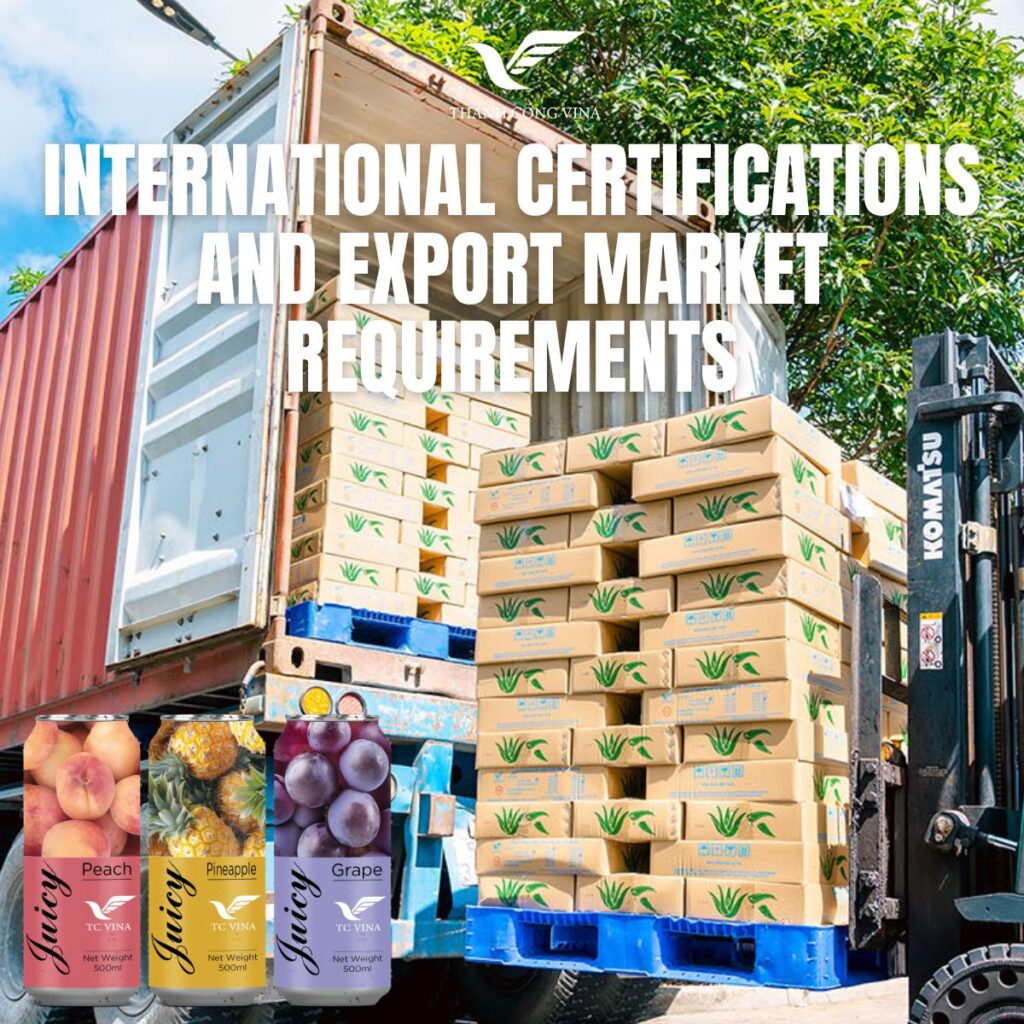
A major advantage of working with a professional Beverage Factory Vietnam is the ability to prepare products for international markets.
European Market Considerations
European buyers often place strong emphasis on food safety, traceability, ingredient compliance, labeling, and documentation.
Manufacturers supplying Europe should therefore work closely with buyers to ensure that formulas and packaging meet applicable requirements.
Middle Eastern Market Requirements
The Middle East represents an important destination for beverage products.
In addition to food safety and product quality, halal compliance may be particularly important depending on the market and customer.
A factory with appropriate halal certification can support brands targeting this region.
Asian Markets
Asian markets have diverse consumer preferences and regulatory requirements.
Product formulations may need to be adjusted according to local tastes, sweetness preferences, packaging expectations, or labeling regulations.
Vietnam’s geographic position can provide logistical advantages for businesses targeting other Asian countries.
North American Markets
North American customers may have detailed requirements regarding ingredients, labeling, nutrition information, product claims, and manufacturing documentation.
Brands should review requirements early in the product development process to avoid expensive reformulation or packaging changes later.
Documentation for Global Buyers
International customers may request documents such as:
- Product specifications
- Ingredient declarations
- Nutrition information
- Certificates
- Laboratory reports
- Certificate of origin
- Packaging specifications
- Shelf-life information
- Batch records
- Export documentation
A professional factory should have systems in place to manage these requirements efficiently.
Conclusion
Choosing a certified Beverage Factory Vietnam is about much more than finding a competitive production price. International beverage brands need manufacturing partners that can combine modern production technology, reliable raw material management, strong R&D capabilities, comprehensive quality control, international certifications, flexible packaging solutions, and export expertise.
Certifications such as HACCP, ISO-based food safety systems, FSSC 22000, and HALAL can provide valuable evidence of structured manufacturing and food safety management. However, buyers should also evaluate how these systems are implemented in daily operations. Raw material inspection, process monitoring, laboratory testing, traceability, sanitation, documentation, and corrective actions are all essential components of reliable beverage manufacturing.
Vietnam provides an attractive manufacturing environment because of its tropical agricultural resources, growing food-processing sector, competitive production capabilities, skilled workforce, and strategic location in Southeast Asia. These advantages make the country well positioned to serve international private label, OEM, and ODM beverage businesses.
For global brands seeking an experienced manufacturing partner, Thanh Cong Vina IEP CO., LTD provides integrated beverage OEM and ODM solutions covering product development, ingredient sourcing, fruit juice manufacturing, coconut water, aloe vera beverages, coffee drinks, customized formulations, packaging, quality control, and export production. With a focus on food safety, product consistency, international B2B requirements, and scalable manufacturing, Thanh Cong Vina supports beverage brands from initial concept through commercial production. For businesses looking for a reliable Beverage Factory Vietnam with international certifications and export-oriented capabilities, Thanh Cong Vina provides a strong foundation for long-term beverage development and global market expansion.
