
Products Knowledge
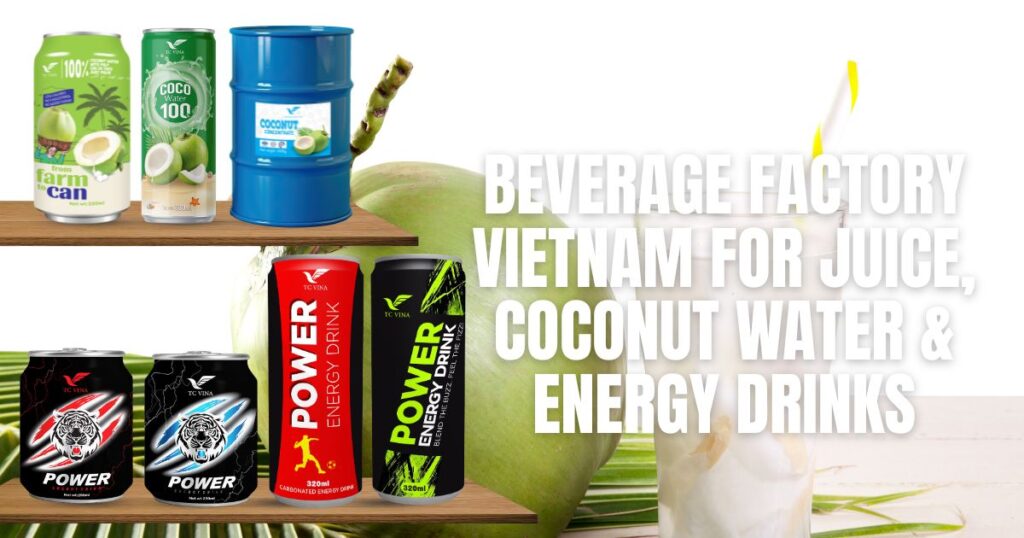
Beverage Factory Vietnam for Juice, Coconut Water & Energy Drinks
Jul
The global beverage industry is continuously evolving as consumers look for convenient, flavorful, and functional drinks that fit modern lifestyles. This growth creates opportunities for beverage brands, importers, distributors, retailers, and private label businesses seeking reliable manufacturing partners in Asia. For companies looking to develop and scale beverage products, choosing the right Beverage Factory Vietnam can provide access to competitive manufacturing capabilities, diverse ingredients, flexible production solutions, and export-oriented services.
Vietnam has become an attractive destination for beverage manufacturing because of its agricultural resources, food-processing capabilities, skilled workforce, and strategic position within Asia. A professional beverage factory can manufacture a wide range of products, from fruit juices and coconut water to energy drinks and other ready-to-drink beverages.
For international businesses, the value of a manufacturing partner extends beyond production. Product development, ingredient sourcing, quality control, packaging, certifications, private label support, and export preparation all influence the success of a beverage project.
By partnering with an experienced Beverage Factory Vietnam, global brands can reduce manufacturing complexity while developing products tailored to specific markets, price points, packaging formats, and consumer preferences.
1. Why Vietnam Is Becoming a Strategic Beverage Manufacturing Hub
Vietnam has developed a strong position within the Asian food and beverage manufacturing ecosystem. Its combination of agricultural resources, manufacturing infrastructure, export connectivity, and competitive production costs makes the country an increasingly attractive destination for international beverage companies.
Strong Agricultural Resources
One of Vietnam’s major advantages is its access to a wide variety of agricultural ingredients.
The country produces tropical fruits such as mango, pineapple, passion fruit, guava, coconut, dragon fruit, lychee, and many other ingredients used in beverage manufacturing.
This agricultural diversity provides manufacturers with opportunities to develop products using locally sourced or regionally available ingredients.
For fruit juice brands, access to raw materials can help manufacturers develop products with distinctive tropical profiles while supporting more efficient sourcing strategies.
Established Food Processing Capabilities
Vietnam’s food-processing industry has expanded significantly, creating a growing ecosystem of suppliers, manufacturers, packaging companies, logistics providers, and supporting industries.
A modern Beverage Factory Vietnam can integrate multiple stages of beverage manufacturing, including water treatment, ingredient preparation, blending, processing, filling, packaging, quality control, and storage.
This integrated capability is particularly valuable for international brands that need consistent production and reliable supply.
Competitive Manufacturing Environment
Vietnam can offer competitive manufacturing economics compared with several other production destinations.
Labor availability, regional ingredient sourcing, manufacturing infrastructure, and access to Asian supply chains can contribute to competitive production costs.
However, international buyers should evaluate suppliers based on total value rather than unit price alone. Product quality, certifications, production capacity, MOQ, lead time, packaging, logistics, and communication should all be considered when selecting a supplier.
Strategic Location in Asia
Vietnam’s geographical location provides convenient access to major Asian markets.
This is beneficial for beverage companies targeting countries across Southeast Asia, East Asia, the Middle East, and other international markets.
For global brands, manufacturing in Vietnam can therefore become part of a broader regional sourcing strategy.
2. Juice Manufacturing Capabilities at a Beverage Factory Vietnam
Fruit juice remains one of the most versatile beverage categories in the global market. Consumers increasingly seek convenient fruit-based beverages with recognizable flavors and attractive nutritional positioning.
A capable Beverage Factory Vietnam can support brands across different juice formats, recipes, packaging styles, and market requirements.
Fruit Juice Product Development
Fruit juice manufacturing begins with product concept development.
Brands may request a specific fruit profile, sweetness level, texture, color, acidity, or nutritional positioning.
Common product concepts include:
- Mango juice
- Pineapple juice
- Passion fruit juice
- Orange juice
- Pink guava juice
- Peach juice
- Lychee juice
- Soursop juice
- Dragon fruit beverages
- Mixed fruit drinks
The manufacturer’s R&D team can help transform the concept into a commercially viable formula.
Ingredient Preparation and Processing
Once the formula has been approved, ingredients must be prepared according to established manufacturing procedures.
Depending on the product, fruit ingredients may be processed into juice, puree, concentrate, or other fruit-based preparations.
The production process must maintain appropriate control over factors such as flavor, acidity, soluble solids, color, texture, and microbiological safety.
Consistency Across Production Batches
Consistency is essential for beverage brands.
Customers expect a product purchased today to deliver the same experience as one purchased several months later.
A professional factory therefore uses standardized formulas, controlled processing parameters, approved raw materials, and documented quality procedures.
These systems help reduce variation between production batches.
Packaging Options for Juice
Juice products can be developed in various packaging formats depending on the target market.
Potential options include PET bottles, cans, glass bottles, cartons, and other commercially suitable formats.
Packaging selection should consider shelf life, transportation, retail environment, consumer convenience, product positioning, and target cost.
For private label brands, packaging is also an important element of brand differentiation.
3. Coconut Water Production for Global Beverage Brands
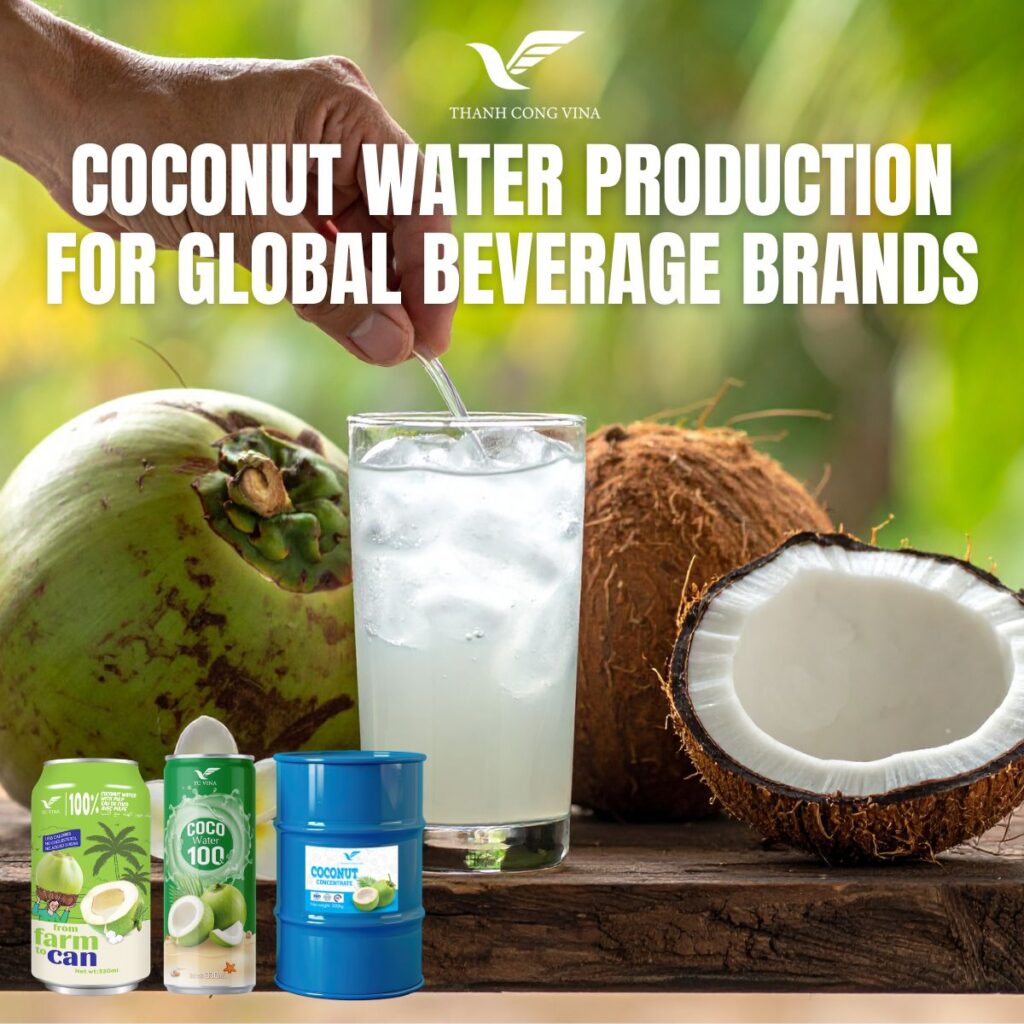
Coconut water has become an important category within the international beverage industry, particularly among consumers interested in naturally positioned hydration products.
Vietnam’s coconut-growing regions provide opportunities for manufacturers to develop coconut-based beverages for both domestic and export markets.
Natural Coconut Water
Coconut water is naturally associated with tropical hydration and refreshment.
For brands entering this category, maintaining the product’s natural sensory characteristics is essential.
Manufacturing processes should be designed to preserve desirable flavor, aroma, appearance, and quality while ensuring product safety and commercial stability.
Coconut Water Product Formats
A professional Beverage Factory Vietnam can manufacture coconut water in different packaging formats and volumes.
Common formats may include:
- Small single-serve bottles
- Larger PET bottles
- Cans
- Cartons
- Private label formats
- Retail-ready multipacks
The appropriate format depends on the target market and distribution channel.
Convenience stores may prioritize single-serve packaging, while supermarkets and foodservice businesses may require larger formats or multipacks.
Custom Coconut Water Formulations
Although traditional coconut water remains popular, brands may also explore flavored or functional variations.
Potential concepts can include coconut water with fruit flavors or other ingredients.
Customization allows brands to differentiate themselves from standard products and develop unique market propositions.
Export Considerations
International coconut water projects require careful attention to labeling, product specifications, packaging, documentation, and destination-market requirements.
A manufacturer with export experience can help coordinate these requirements during product development and production.
For international buyers, this can simplify communication and reduce the operational complexity of sourcing from Vietnam.
4. Energy Drink Manufacturing and Functional Beverage Opportunities
Energy drinks represent another important beverage category for manufacturers serving global brands.
Consumers seek products associated with energy, focus, convenience, performance, and active lifestyles.
For this reason, brands often require highly customized formulas and packaging concepts.
Developing Energy Drink Formulas
Energy drink development requires careful consideration of ingredients, flavor, sweetness, acidity, mouthfeel, and regulatory requirements.
Depending on the target market, formulations may include ingredients such as caffeine, vitamins, minerals, botanical components, or other functional ingredients permitted under applicable regulations.
The exact formulation should always be developed according to the regulations of the intended market.
Flavor Development
Energy drinks are often associated with bold and distinctive flavors.
Manufacturers can work with brands to develop profiles such as citrus, berry, tropical fruit, apple, or other customized concepts.
Flavor selection should reflect the target consumer group and market positioning.
Packaging and Brand Positioning
Packaging plays a significant role in the energy drink category.
Cans are commonly associated with convenience and modern lifestyle positioning, while other formats may be appropriate for specific retail channels.
A strong visual identity can help a new energy drink stand out in a highly competitive category.
Quality and Regulatory Control
Energy beverages may require additional attention to ingredient specifications and labeling requirements.
An experienced manufacturer should be able to provide documentation and quality information relevant to the ingredients and finished product.
International brands should confirm all regulatory requirements before finalizing formulas and packaging.
5. OEM and Private Label Solutions for International Beverage Brands
One of the most valuable advantages of working with a professional Beverage Factory Vietnam is the ability to develop OEM and private label products.
This model allows companies to create their own branded beverages without establishing their own production facility.
OEM Beverage Manufacturing
OEM manufacturing enables brands to provide product specifications while the manufacturer handles production.
This model is suitable for companies with established formulas, product concepts, or detailed technical requirements.
The manufacturer follows approved specifications to produce the final beverage.
ODM Product Development
ODM manufacturing provides a higher level of development support.
A brand may have a general product concept but lack the technical resources needed to develop the final formula.
The manufacturer can support formulation development, product sampling, ingredient selection, processing, packaging, and commercialization.
Private Label Beverage Production
Private label manufacturing is particularly attractive to retailers, distributors, importers, entrepreneurs, and emerging brands.
The manufacturer produces the beverage while the customer sells it under its own brand.
This enables companies to enter the beverage industry without investing heavily in factory infrastructure.
Custom Product Portfolios
Private label customers may develop multiple beverages through the same manufacturing partner.
For example, a brand could build a portfolio consisting of:
- Fruit juices
- Coconut water
- Aloe vera drinks
- Coffee beverages
- Energy drinks
- Functional beverages
- Tropical fruit drinks
This creates opportunities for portfolio expansion while simplifying supplier management.
6. Quality Control and International Certifications
Quality assurance is one of the most important factors when evaluating a Beverage Factory Vietnam.
For international buyers, manufacturing quality must be supported by documented systems, appropriate certifications, traceability, and consistent production procedures.
HACCP-Based Food Safety Management
HACCP is widely recognized as a systematic approach to identifying and controlling food safety hazards.
A manufacturer operating under a structured food safety system can better manage risks associated with raw materials, processing, handling, packaging, and storage.
GMP Principles
Good Manufacturing Practices help establish appropriate standards for hygiene, production operations, personnel, equipment, facilities, and quality management.
For beverage production, these practices are fundamental to maintaining a controlled manufacturing environment.
ISO and FSSC Systems
Depending on the facility and customer requirements, manufacturers may operate according to internationally recognized management or food safety standards such as ISO or FSSC 22000.
These systems can provide international buyers with greater confidence in the supplier’s quality-management framework.
HALAL Requirements
For brands targeting Muslim-majority markets, HALAL compliance can be an important commercial consideration.
Ingredients, processing, handling, and documentation should be evaluated according to the applicable requirements.
Quality Testing and Traceability
Quality control should cover the entire manufacturing process.
A professional factory may monitor raw materials, production parameters, packaging integrity, finished product specifications, and microbiological quality.
Batch traceability is equally important because it allows manufacturers to track production information and investigate potential quality issues.
International buyers should request current certification documents and verify the certification scope rather than relying solely on general marketing claims.
7. Packaging, MOQ, and Production Scalability
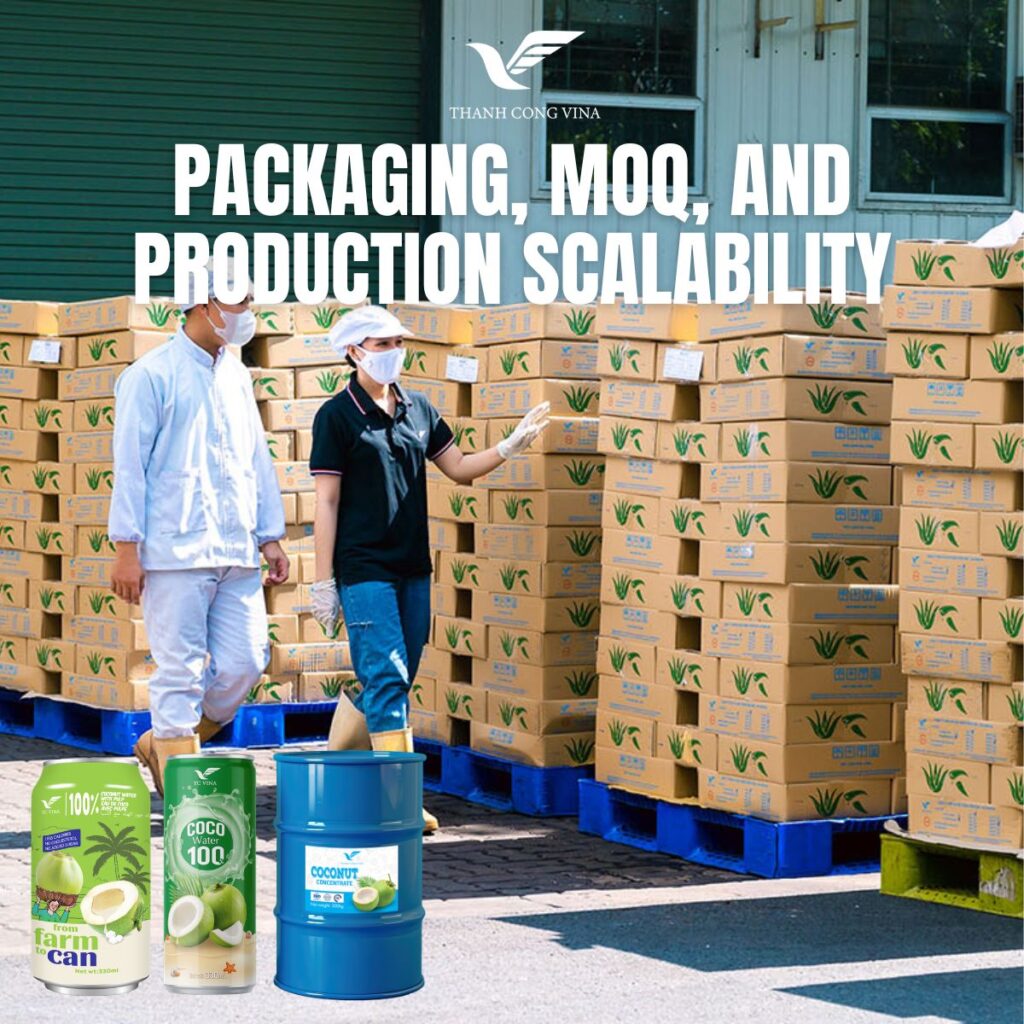
The commercial success of a beverage project depends not only on formulation and quality but also on production economics.
A professional Beverage Factory Vietnam should be able to provide practical solutions for packaging, minimum order quantities, and production scalability.
Packaging Customization
Packaging should be selected based on product characteristics, consumer expectations, retail channels, and logistics requirements.
Possible formats include:
- PET bottles
- Aluminum cans
- Glass bottles
- Aseptic cartons
- Custom labels
- Printed packaging
- Multipack cartons
Each option has different cost, transportation, storage, and branding implications.
Minimum Order Quantity
MOQ is an important consideration for new brands.
A small company may require a lower initial volume to test market demand, while an established distributor may require full-container production.
Buyers should clarify MOQ for both finished products and packaging components before finalizing a project.
Scaling Production
Successful beverage products often require significant increases in volume.
A scalable manufacturer should be able to accommodate growing demand through production planning and capacity management.
This makes the factory a more valuable long-term partner.
Cost Optimization
Manufacturing cost is influenced by many factors, including:
- Formula
- Ingredients
- Packaging
- Production volume
- MOQ
- Product specifications
- Labor
- Logistics
- Testing requirements
- Certification requirements
Brands should therefore compare total project costs rather than evaluating only the quoted price per unit.
8. Export Support and Long-Term Supply Partnerships
For international beverage brands, production is only one part of the supply chain.
A reliable Beverage Factory Vietnam should be able to support export-oriented operations and long-term supply planning.
Export Documentation
International shipments may require various commercial and product documents.
Depending on the destination market and transaction structure, these may include invoices, packing lists, certificates of origin, product specifications, quality documentation, laboratory reports, and other relevant paperwork.
The exact requirements should be confirmed according to the destination country.
Production and Shipment Coordination
Export orders require coordination between manufacturing, packaging, warehousing, container loading, and shipping.
A factory with established export procedures can help streamline these stages.
This reduces unnecessary communication between multiple suppliers.
Reliable Lead Times
Consistent lead times are important for international beverage brands because delays can affect inventory, promotions, retail launches, and customer relationships.
Production planning should consider raw material availability, packaging procurement, production schedules, quality release, and shipping arrangements.
Long-Term Cooperation
The strongest manufacturing relationships are built over time.
As a factory becomes familiar with a brand’s products, packaging specifications, quality standards, forecast patterns, and market requirements, communication can become more efficient.
This can create a stable supply relationship that supports long-term business growth.
Conclusion
Vietnam offers strong opportunities for beverage brands seeking competitive, flexible, and export-oriented manufacturing solutions. With access to tropical agricultural ingredients, developing food-processing infrastructure, skilled manufacturing resources, and regional supply-chain advantages, the country can serve as an effective production base for international beverage businesses.
A professional Beverage Factory Vietnam can support a broad portfolio ranging from fruit juices and coconut water to energy drinks, coffee beverages, aloe vera drinks, and other ready-to-drink products. Through OEM, ODM, and private label services, international brands can develop customized formulas, packaging, and product specifications without investing in their own manufacturing facilities.
For global buyers, the most important consideration is not simply production price. Quality management, certifications, formulation expertise, manufacturing capacity, packaging flexibility, MOQ, export experience, communication, and scalability all contribute to the success of a long-term supplier relationship.
Thanh Cong Vina is positioned to support international beverage brands seeking reliable manufacturing solutions from Vietnam. With an export-oriented approach to beverage production, Thanh Cong Vina can support product development, OEM and ODM manufacturing, private label production, quality control, packaging, and international supply requirements.
For companies developing fruit juice, coconut water, energy drinks, or broader ready-to-drink portfolios, choosing the right Beverage Factory Vietnam can create a strong foundation for efficient production and sustainable global expansion.
