
Company Activity
Beverage Factory Vietnam for Private Label Beverage Manufacturing
A Beverage Factory Vietnam can provide integrated manufacturing solutions covering product development, formula customization, processing, filling, packaging, quality control, and export preparation. Vietnam is increasingly attractive for beverage sourcing because of its diverse agricultural resources, tropical fruit supply, developing food-processing infrastructure, and strong position within Asian supply chains. Private label manufacturing also gives businesses greater flexibility to create products according to their own brand identity, target consumers, packaging preferences, and market requirements. From fruit juice and coconut water to aloe vera beverages, concentrated juices, and ready-to-drink coffee, Vietnamese beverage factories can support a wide range of commercial concepts. Selecting the right factory is therefore an important step for businesses seeking consistent quality, flexible production, and long-term international growth.
1. Why Choose a Beverage Factory Vietnam for Private Label Production?
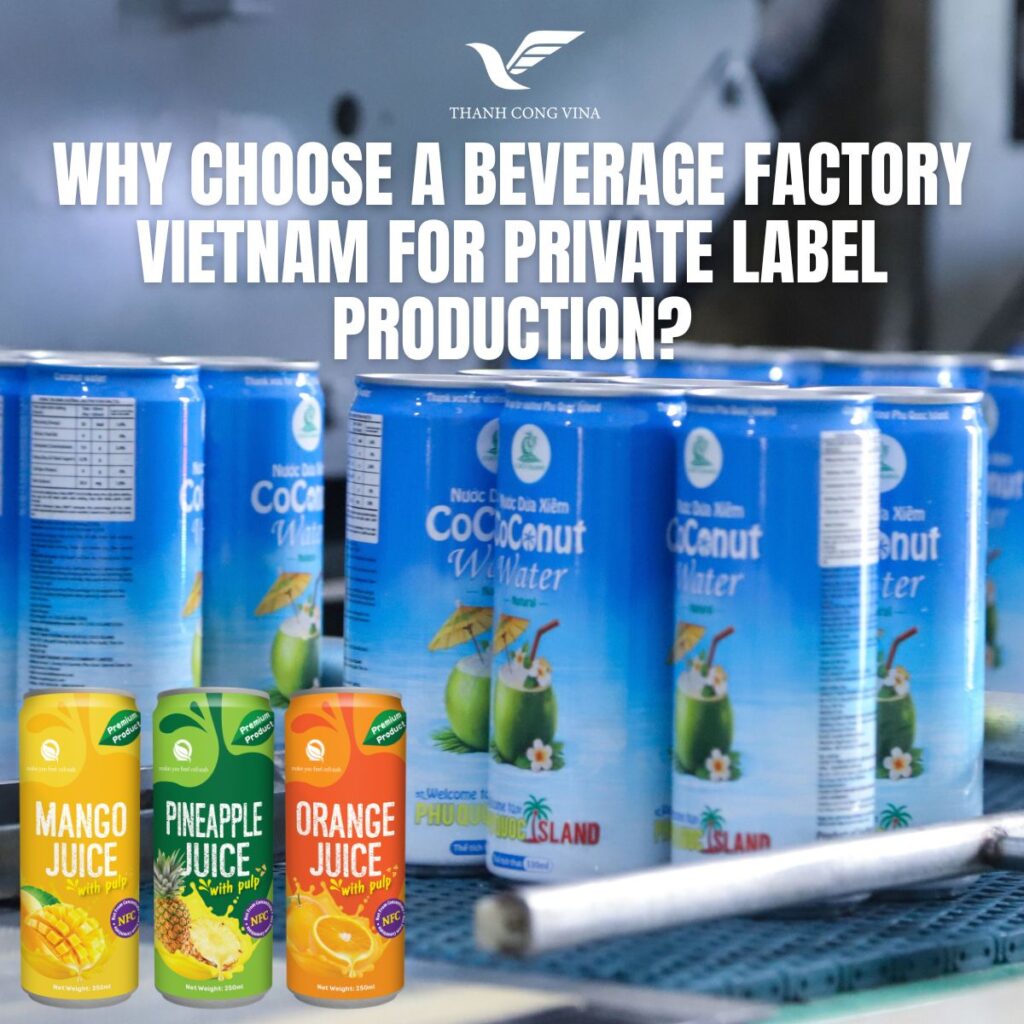
Vietnam has developed a strong food and beverage manufacturing ecosystem that supports both domestic consumption and international trade. For global beverage companies, this creates opportunities to source customized products while maintaining control over their brand identity.
Access to Diverse Agricultural Ingredients
One of Vietnam’s major advantages is its agricultural diversity. The country produces a wide range of tropical fruits and agricultural products that can be used in beverage production.
Mango, pineapple, passion fruit, coconut, orange, guava, peach, dragon fruit, soursop, and other ingredients can be incorporated into different beverage concepts.
This availability gives beverage brands more flexibility when developing new products. A company can begin with several popular flavors and later expand into seasonal or market-specific varieties.
Local sourcing can also provide manufacturers with greater familiarity with regional raw materials and supply conditions, supporting product development and production planning.
Developing Food and Beverage Infrastructure
Vietnam’s food-processing industry has expanded considerably, creating more opportunities for international businesses to work with professional manufacturing partners.
Modern beverage factories can provide integrated production services instead of simply performing filling operations. Depending on the manufacturer, these services may include formulation, ingredient preparation, processing, filling, packaging, quality inspection, warehousing, and export support.
This integrated approach can simplify communication for buyers who want to manage their product development through a single manufacturing relationship.
Export-Oriented Manufacturing
Many Vietnamese beverage manufacturers work with international buyers and understand the importance of export specifications.
For international projects, production planning may involve customized labels, packaging requirements, product specifications, quality documentation, and shipment preparation.
An export-oriented factory can therefore become more than a production supplier. It can act as a manufacturing partner throughout the product development and supply-chain process.
2. Beverage Factory Vietnam: Private Label Manufacturing Process
A successful private label beverage requires coordination between product concept, formulation, manufacturing, packaging, and quality management. A professional factory should be able to guide buyers through the main stages of development.
Product Concept Development
The process typically begins with the buyer’s product concept. The brand may provide information about the desired beverage category, target consumers, flavor profile, packaging size, market positioning, and destination market.
For example, a retailer may want to launch a tropical fruit juice drink under its own brand. An importer may request 100% coconut water in a specific package size. A startup may want to create a customized beverage line with several flavors.
The factory can evaluate the concept and identify suitable production options based on technical and commercial requirements.
Formula Development and Customization
Formula development is one of the most important stages of private label production. Instead of using a standard product, the buyer can work with the manufacturer to develop a beverage according to specific requirements.
The formulation may involve adjustments to fruit content, sweetness, acidity, flavor intensity, texture, and other product characteristics.
The objective is to achieve a consistent product that reflects the brand’s positioning while remaining suitable for commercial-scale production.
Sampling and Approval
Before mass production, product samples allow buyers to evaluate the proposed formulation.
Samples can be reviewed for taste, aroma, color, appearance, texture, and overall product experience. If changes are necessary, the manufacturer can adjust the formula and provide additional samples.
Once the buyer approves the final product specification, the project can move forward to packaging preparation and commercial production.
3. Product Categories Manufactured by a Modern Beverage Factory
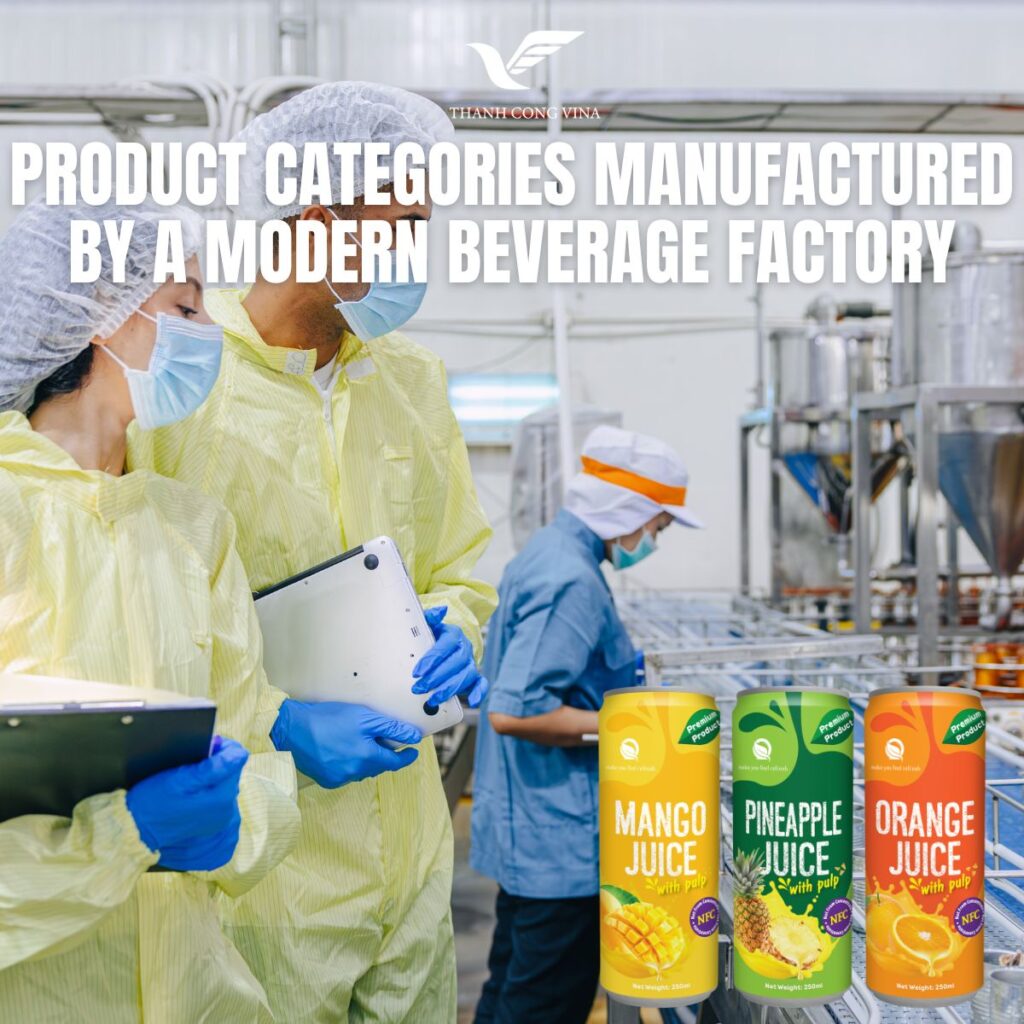
A diversified beverage factory can support different product categories, allowing brands to develop multiple products through one manufacturing partner.
Fruit Juice Drinks
Fruit juice drinks are among the most flexible beverage categories for private label development.
Manufacturers can produce different fruit-based concepts, including mango, orange, strawberry, lychee, red grape, pineapple, passion fruit, peach, guava, soursop, and other combinations.
Different formulations can be developed according to the target market and desired product positioning.
For international brands, fruit beverages can also provide opportunities to introduce tropical flavors that differentiate their portfolio from conventional beverage products.
Coconut Water and Coconut Beverages
Vietnam’s coconut resources support the development of coconut-based beverages.
A factory may produce 100% coconut water as well as coconut water combined with fruit juice. Flavors such as mango, strawberry, calamansi, or kiwi can create additional product variations.
Different package sizes can also be developed depending on the buyer’s distribution strategy.
Aloe Vera Drinks
Aloe vera beverages offer another opportunity for private label brands seeking products with a distinctive texture and visual appearance.
Aloe vera drinks can be developed with different flavor profiles, including mango, blueberry, lychee, peach, and original concepts.
These products can be positioned for supermarkets, convenience stores, hospitality businesses, and other retail channels depending on the target market.
Ready-to-Drink Coffee
Vietnam has a strong coffee culture and established coffee-processing capabilities. This creates opportunities for ready-to-drink coffee production.
Private label RTD coffee can include concepts such as black coffee, milk coffee, latte, and cappuccino.
Convenient packaging allows these products to target consumers looking for ready-to-consume coffee products in retail and foodservice environments.
4. Quality Control at a Beverage Factory Vietnam
Quality management is a critical factor when choosing a manufacturing partner. International buyers need consistent products that meet agreed specifications throughout repeated production batches.
Raw Material Inspection
The production process begins with raw material control. Ingredients should be evaluated according to the established product specifications before entering manufacturing.
Depending on the material, quality checks may include documentation, physical condition, storage requirements, and other relevant parameters.
Consistent raw material management helps reduce variation in the finished beverage.
Controlled Production Processes
During manufacturing, production stages should follow established procedures and approved product specifications.
Ingredient handling, blending, processing, filling, and packaging need to be coordinated to maintain consistency between batches.
Quality-control teams can monitor relevant production stages and verify that the product is manufactured according to the agreed requirements.
Finished Product Inspection
Finished products can be inspected before shipment. Checks may include product appearance, taste, packaging condition, coding, quantity, and other relevant specifications.
For export products, traceability and production documentation are also important. Clear records can help buyers manage their supply chain and communicate effectively with distributors or import partners.
5. Customized Packaging for Private Label Beverage Brands
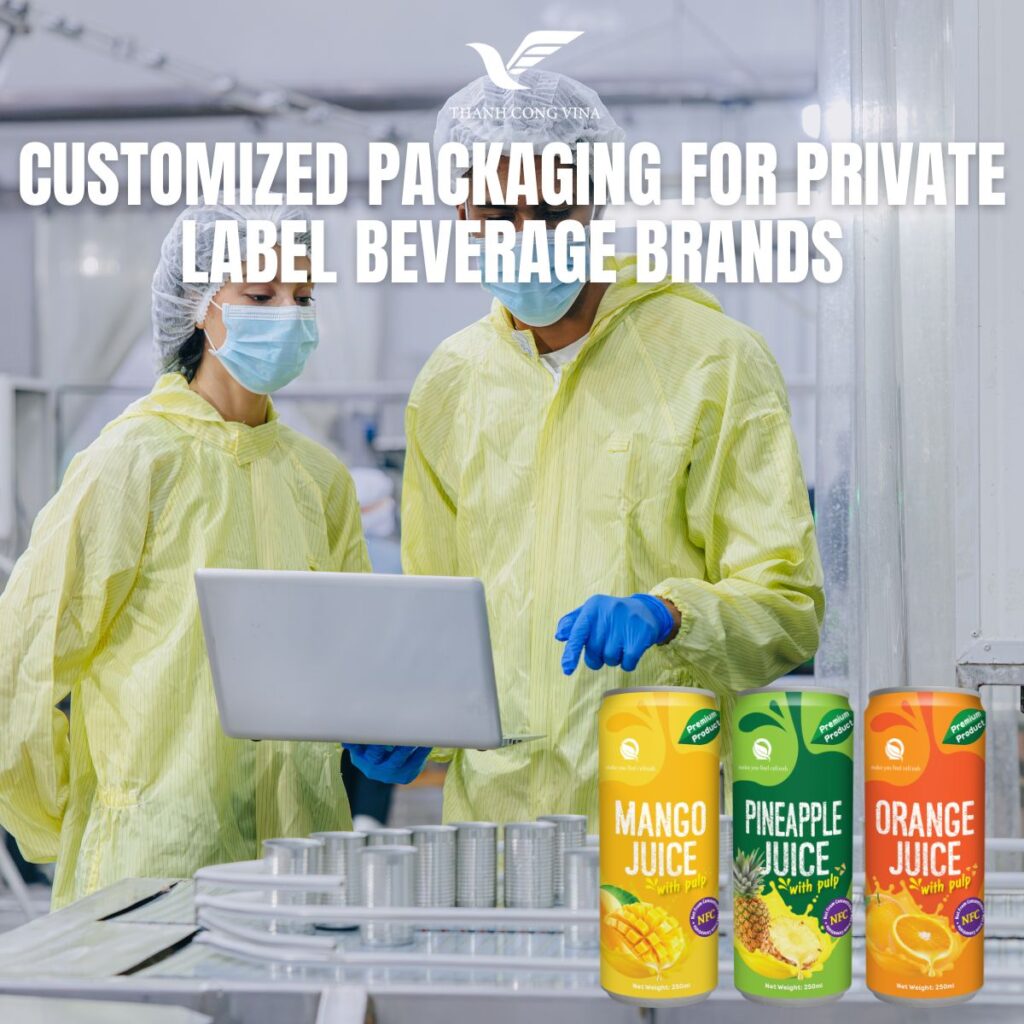
Packaging is a major component of private label manufacturing because it connects the finished product with the brand’s visual identity.
Choosing the Right Package Format
Different beverages require different packaging solutions. Depending on the product, factories may support cans, PET bottles, glass bottles, and other suitable formats.
Common beverage sizes can include 250ml, 320ml, 330ml, 500ml, and customized formats.
The appropriate package depends on the product category, target consumers, distribution channel, transportation requirements, and brand positioning.
Custom Labels and Artwork
Private label beverages require customized packaging that communicates the brand’s identity.
Labels can include brand names, logos, product descriptions, ingredient information, nutrition facts, barcodes, storage instructions, and other information required by the destination market.
Artwork should be prepared according to the technical requirements of the selected packaging format. Proper coordination between the buyer, designer, packaging supplier, and factory can reduce production errors.
Secondary Packaging
Secondary packaging protects individual beverage units during storage and transportation.
Cartons, trays, pallets, and other packaging components should be considered during the product development stage. For international shipments, packaging configuration can also influence container utilization and logistics costs.
6. Commercial Benefits of Working with a Beverage Factory
Private label manufacturing provides businesses with an alternative to building their own beverage production infrastructure.
Reduced Investment Requirements
Establishing a beverage factory requires investment in land, buildings, processing equipment, filling systems, quality laboratories, employees, maintenance, utilities, and food safety management.
By working with an established manufacturing partner, beverage brands can focus more resources on product development, marketing, sales, and distribution.
This model can be particularly useful for startups, retailers, importers, and businesses testing new beverage categories.
Flexible Minimum Order Quantities
Minimum order quantities vary depending on the beverage category, packaging, ingredients, and production requirements.
Understanding MOQ before starting a project helps buyers plan their inventory and financial resources.
A professional manufacturer can explain the production requirements associated with customized packaging and commercial orders.
Scalable Production
A beverage brand may begin with a limited product portfolio and gradually expand as market demand develops.
A scalable manufacturing relationship allows businesses to introduce additional flavors, package sizes, or beverage categories without necessarily changing their manufacturing strategy.
This can support long-term product portfolio development and supply-chain continuity.
7. Export Support from a Beverage Factory Vietnam
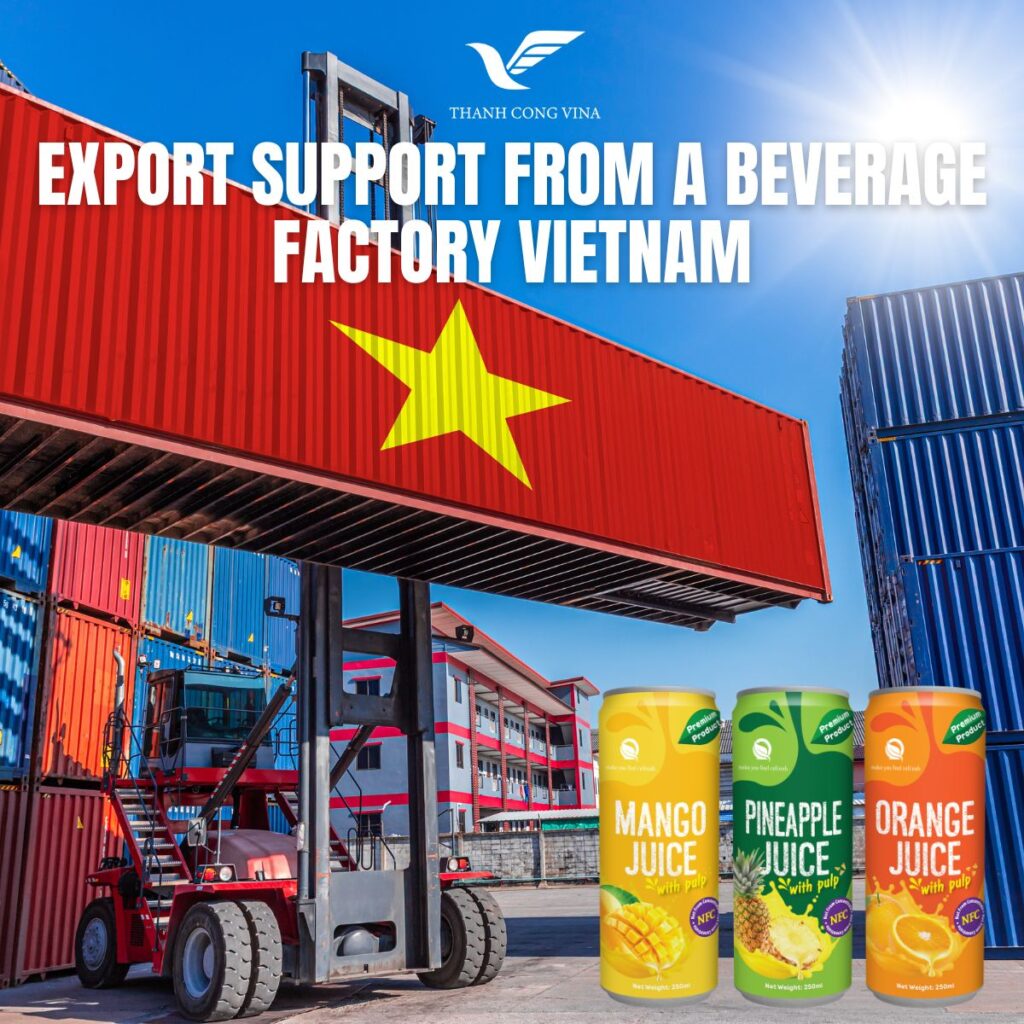
For international buyers, manufacturing and export preparation are closely connected. A factory should understand that the final objective is not simply to produce the beverage but to prepare it for international distribution.
Destination Market Requirements
Different markets may have different regulations concerning ingredients, labeling, packaging, product registration, and food safety.
Buyers should communicate their destination-market requirements before production begins. The manufacturer can then coordinate product specifications and packaging information accordingly.
Export Documentation
International beverage shipments may require various commercial and product-related documents.
Depending on the destination and purchasing arrangement, buyers may request product specifications, certificates, shipment information, and other documentation.
Clear documentation helps importers manage customs procedures and maintain product records.
Shipment and Container Planning
Beverages are generally shipped in commercial quantities, making logistics planning essential.
Carton dimensions, pallet configuration, total order quantity, product weight, and container capacity should be considered when preparing an export shipment.
Coordinating these factors early can support more efficient loading and help minimize avoidable logistical issues.
8. How to Select the Right Beverage Factory in Vietnam
Choosing the right factory is one of the most important decisions in a private label beverage project.
Evaluate Product Capabilities
Buyers should confirm that the manufacturer has the equipment and experience required for their specific beverage category.
A factory capable of producing fruit juice, coconut water, aloe vera drinks, concentrated juices, and RTD coffee can provide greater flexibility for brands with multiple product concepts.
Review OEM and ODM Services
OEM manufacturing focuses on producing products according to the buyer’s specifications, while ODM services can provide additional support for product development.
For brands without their own technical beverage team, access to formula development and sampling support can simplify the product launch process.
Check Quality Certifications and Systems
International buyers should review the manufacturer’s food safety and quality-management systems.
Depending on the project, relevant certifications and standards may include HACCP, ISO, HALAL, FDA-related requirements, GMP, FSSC 22000, or other applicable standards.
The specific requirements should always be evaluated according to the product and destination market.
Assess Communication and Customer Support
International manufacturing projects involve many stages and details. Clear communication is therefore essential.
The factory should be able to discuss product specifications, samples, packaging artwork, MOQ, production schedules, quality requirements, and shipping arrangements in a structured manner.
Good communication can reduce misunderstandings and make the overall manufacturing process more efficient.
Conclusion
Vietnam has become an increasingly relevant sourcing destination for international beverage businesses because of its agricultural resources, food-processing capabilities, manufacturing infrastructure, and export-oriented supply chain. A Beverage Factory Vietnam can provide more than commercial production, offering integrated support across product development, formula customization, sampling, processing, filling, packaging, quality control, and export preparation. For private label brands, this model can reduce the investment required to establish independent manufacturing infrastructure while providing flexibility to develop products for specific consumer and market requirements. Thanh Cong Vina supports global businesses with customized OEM, ODM, and private label beverage solutions across categories including fruit juice, coconut water, aloe vera beverages, concentrated juice, and ready-to-drink coffee. With an integrated approach to product development and production, Thanh Cong Vina can help international brands build scalable beverage portfolios and establish reliable supply chains. For businesses looking for an experienced Beverage Factory Vietnam, Vietnam offers a practical foundation for customized beverage manufacturing and international market expansion.
